A review of Unitree's new hand: the spec sheet, a comparison with Wuji, and why it’s so cheap.
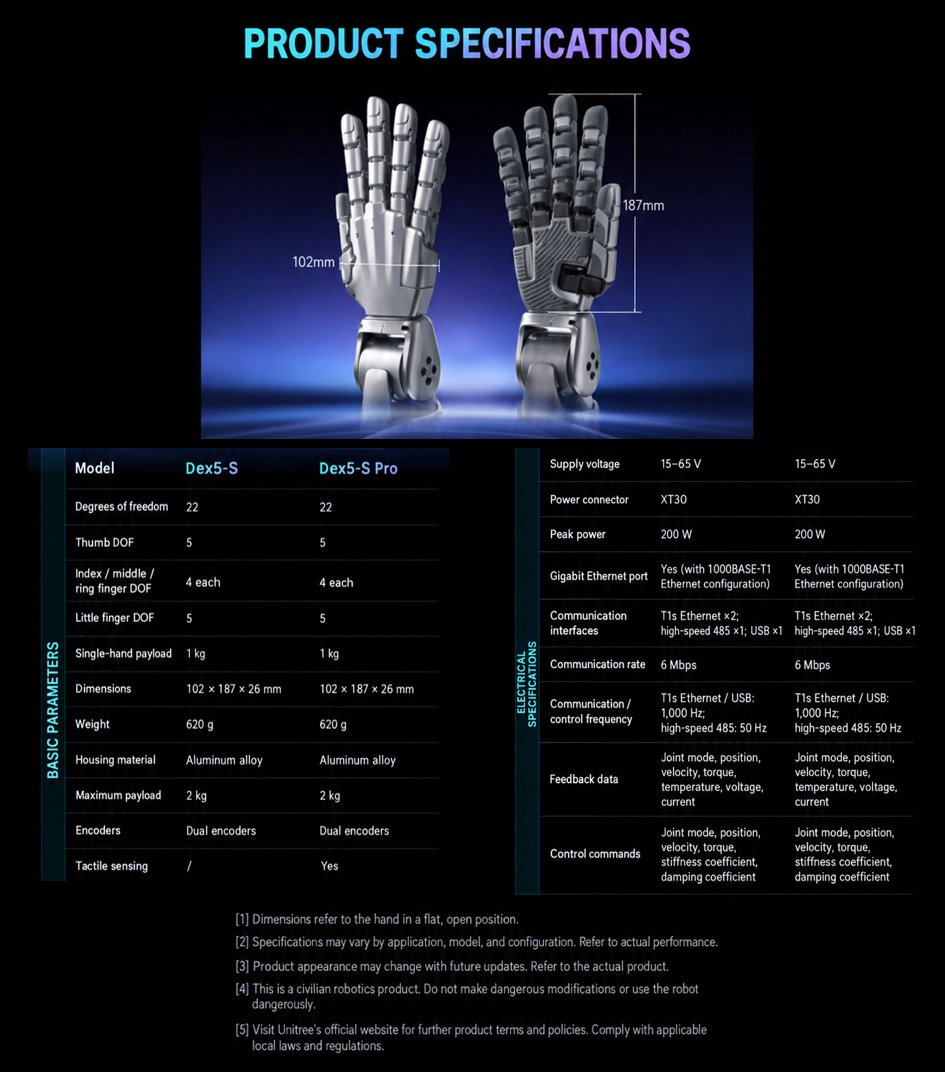
A quick rundown of the specs:
Human proportions (187 × 102 mm)
High DOF count
Very low strength (more on this later)
Tactile sensing only in the Pro version
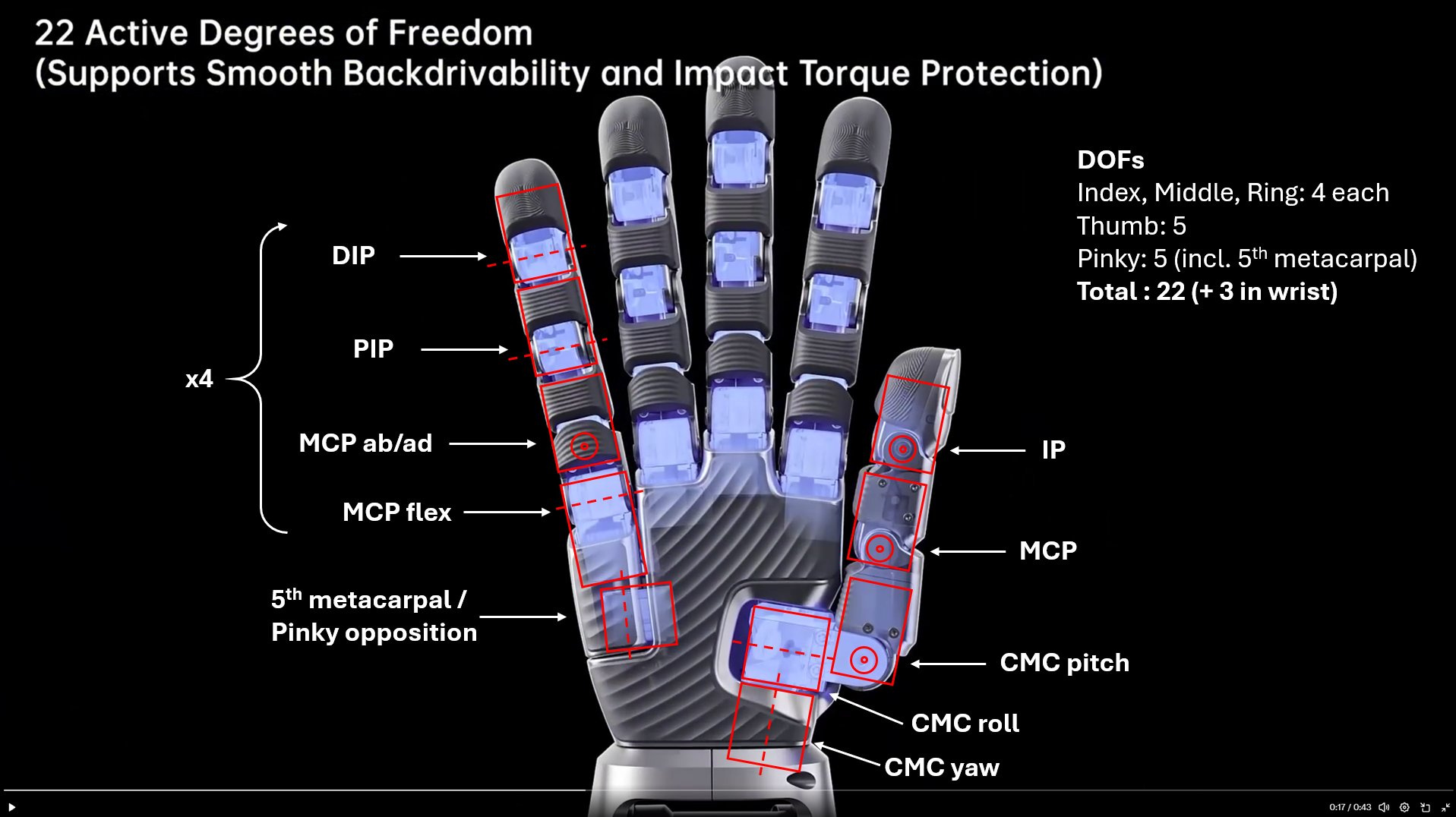
The DOF count is as good as it gets:
Thumb: 5
Index, middle, ring: 4 each
Pinky: 5
Wrist: 3
That’s 25 DOFs in total, all independently actuated.
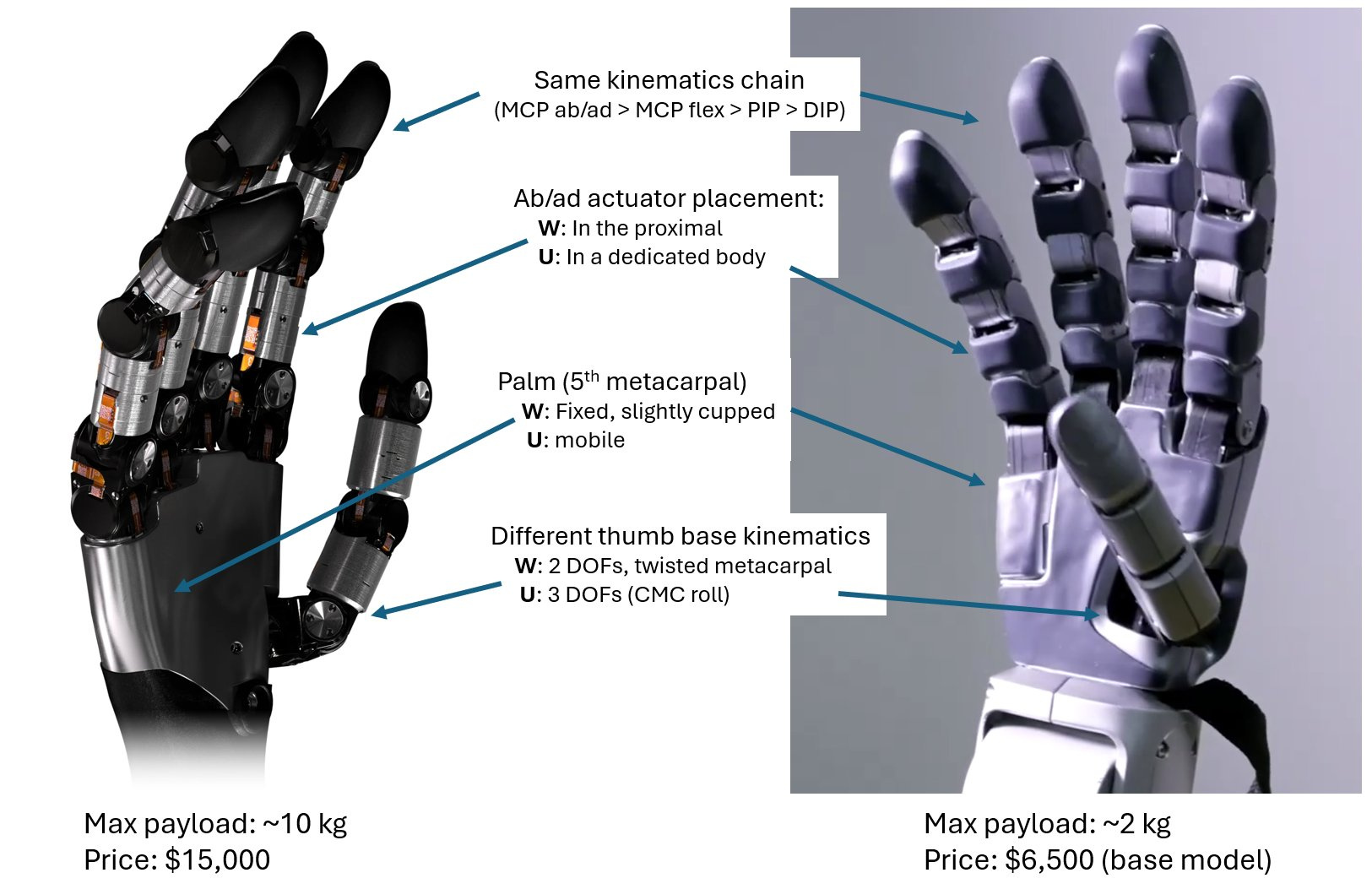
The architecture is similar to Wuji's, with some differences.
Similarities
Actuator placement in the phalanges (“direct-drive”)
Kinematic chains of the four non-thumb fingers
Differences
Thumb base kinematics (Unitree’s design is excellent)
Mobile palm (its utility is debatable)
Ab/ad actuator placement
Strength and price
The most striking difference between the two hands is strength.
Wuji’s achievement isn’t making a small hand. It’s pushing torque density as far as this architecture allows. The actuators are the structure, no volume is wasted.
Not the case for Unitree.
Actuators account for 70–90% of a hand’s BOM cost. Unitree’s hand is cheap because its actuators are small and weak.
Strength is a fundamental limitation of direct-drive hands, and the reason tendon-driven hands will eventually dominate robotics.
The biggest engineering mistake I made at Figure was building a tendon-based hand
Our first hand design in 2022 was a tendon hand for our F.01 robot. At a high level, the tendon approach sounds appealing, which is why I chose it: you get more space for packaging actuators since…
11 DOFs total. Really bad for tendon-driven. Everyone else packs in twice as many.
Wrist yaw is actuated with the same motors as fingers, way too weak.
I think there's no wrist pitch, but I am not sure.
Makes me think that there's no pitch:
I count 12 actuators (3 levels, 4 actuators each)
I see no joint
Maybe there's pitch:
It would be too stupid to eliminate that DOF
Actuation
Bidirectional actuators pull different tendons depending on spin direction. Same approach as Kyber Labs and 1X.
Tendons wrap a reel, and route through pulleys. The reel takes a lot of volume, so the actuators are small and weak.
At the wrist, tendons get into the wrist structure and exit in bowden tubes that carry them to the joints.
The failure mode
Bowden tubes induce friction, and with it two problems:
Poor controllability (worse with weak actuators)
Poor reliability: tendons fray and break
Figure moved away from tendons when they should've moved away from bowden tubes, or optimized tube friction like 1X.
Summary
Bad hand, calling it a work of art is... lol.
There were good ideas worth iterating on: pulley routing, bidirectional actuation
Nowhere near exhausting tendon hands' potential.
Brett Adcock lacks first-principle hardware intuition. Figure's AI stack is great, but the hardware over-indexes on industrial design, under-indexes on performance. On hands, they're being left behind.
PIP and DIP flexion appear coupled in the videos, which is why the hand defaults to a pinch grip (👌🏻) rather than a flat grip (🤏🏻). A flat grip is inherently more stable, especially on small objects: it maximizes contact area and uses the full pulp of the fingertip.
The thumb architecture is an interesting choice. 1X included thumb pronation/supination (axial rotation) but skipped abduction/adduction, which is the more common choice in humanoid hands. I loved how the Wuji hand solved this: it keeps ab/ad, then gets some axial rotation "for free" by angling the MCP/IP flexion axes relative to the CMC flexion axis.
Tendon actuation
1X uses rotary actuators, each driving both the flexion and extension tendons of a joint. Same approach as Kyber Labs. This gives them excellent control over joint actuation, but it introduces a challenge. As tendons stretch or slip, slack enters the system and creates joint backlash. They fixed this by making the tendons easily accessible so they can be re-tensioned, which will require a technician.
You can also see how much engineering went into the tendons themselves. The size gap between the tendon and its Bowden tube suggests at least 4 layers:
stiff load-bearing rope
low-friction sacrificial layer
the Bowden tube's metal spring coil
an outer sheath protecting it
Wrist actuation
I really like how they did this. The differential is compact, efficient, and stays out of the way of the tendons. Two rotary actuators drive a capstan mechanism (mirrored on the other side). Turn the actuator clockwise → the hand tilts left and flexes toward the camera (red arrows). Counterclockwise does the reverse. How much it tilts vs. flexes depends on what the second actuator is doing and how the other two ropes wrap the joint.